The softness or stiffness of a textile resin film affects fabric feel, blocking resistance, and the ability of a print layer to withstand rubbing and deformation. A film that is too soft or too hard for its application may affect the finished textile during processing, storage, and use.
“Too soft” and “too hard” depend on the intended application. Prints on soft clothing fabrics and backcoatings that require a firm handle have different film requirements.
Films That Are Too Soft: Tackiness, Blocking, and Print Wear
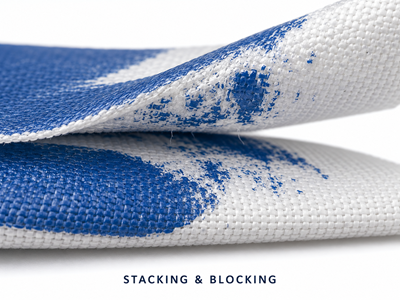
Printed surfaces may remain in contact for extended periods when garments are folded and packed. Under elevated temperatures and stacking pressure, an overly soft resin film with high surface tack may stick to another printed surface. Separating the surfaces can leave impressions or damage the print, creating additional inspection and rework.
If a textile printing binder forms an overly soft film with insufficient cohesive strength, repeated rubbing may cause localized wear, uneven color, or blurred print edges. A tacky surface can also pick up dust and lint, affecting the appearance of the design.
A soft water-based textile resin therefore needs adequate film strength and resistance to residual tack to protect the print while maintaining a soft hand.
Films That Are Too Hard: Stiff Fabric Feel and Cracking During Stretching
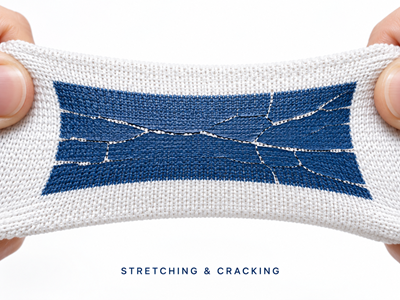
An overly stiff resin film can restrict fabric bending and make the printed area feel harder than the surrounding material. This can affect softness, drape, and wearing comfort. The difference is often more noticeable on lightweight fabrics or large printed areas.
On stretch fabrics, an overly hard film with insufficient elongation may crack as the fabric stretches. Repeated stretching or folding can increase the damage around these cracks and reduce print integrity.
Binders for elastic textile printing need to accommodate fabric deformation. Fabric finishing and backcoating applications that require a firm handle have different requirements.
Print Damage After Washing: Different Effects of Soft and Hard Films
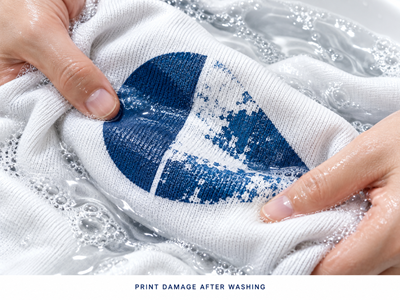
Some customers report that prints made with their previous textile resin became patchy after washing, with localized peeling in some cases.
During washing, printed fabrics undergo repeated rubbing, bending, and pulling. An overly soft film with insufficient strength may wear away, leaving patchy areas or blurred edges. An overly hard film with insufficient flexibility may crack during repeated bending. As the cracks grow, sections of the print may break away.
The same complaint—“the print becomes patchy after washing”—can describe different types of damage. An overly soft film may suffer abrasion damage, while an overly hard film may crack under deformation. Both can reduce the integrity of the printed design.
Which Parameters Help Explain Textile Resin Film Properties?
Glass transition temperature, or Tg, helps indicate a resin’s tendency toward softness or stiffness, but it is not a direct measurement of dry-film hardness. Solids content and emulsion viscosity mainly provide formulation and processing information. Neither directly measures wash durability or resistance to cracking.
The following table compares typical parameters published for three water-based acrylic emulsions:
|
Typical Properties
|
PA-511
|
PA-510
|
PA-512
|
|
Tg
|
−20
|
−16
|
20
|
|
Solids content (%)
|
45±1
|
45±1
|
48±1
|
|
Viscosity at 25°C (cP)
|
600–1200
|
500–1000
|
200–500
|
|
Film characteristics
|
Soft hand, high elasticity
|
High elasticity, soft film
|
Firm handle
|
PA-511 Soft Self-Crosslinking Acrylic Emulsion combines a soft hand with resistance to residual tack. PA-510 High-Elasticity Water-Based Acrylic Emulsion is intended for applications including elastic textile printing. PA-512 Hard Self-Crosslinking Acrylic Emulsion emphasizes a firm handle, blocking resistance, and abrasion resistance. These products represent different application requirements, rather than a ranking of “too soft,” “balanced,” and “too hard.”
The same fabric coating resin can produce different results on different fabrics or at different coating thicknesses. Resin selection should account for the substrate and intended use, so the print retains the required feel while withstanding rubbing and deformation during storage, washing, and wear.
Sinograce Chemical supplies water-based resins for textile printing and fabric coatings. Customers are welcome to inquire about product information and samples for testing.
FAQ
1. Why does my textile print become patchy after washing?
Washing subjects the print to rubbing and repeated bending. A film that is too soft and lacks strength may wear, leaving patchy areas. A film that is too hard and lacks flexibility may crack and break apart.
2. Why do printed garments stick together after packing?
A soft resin film with high surface tack may stick to another printed surface under heat and stacking pressure. Separating the garments can leave marks or damage the design. Soft textile prints therefore need adequate blocking resistance.
3. Why does the printed area feel stiff or crack when stretched?
An overly hard film can restrict fabric bending and make the printed area feel stiff. If the film also lacks sufficient elongation, it may crack as the fabric stretches. Elastic textile prints need both a comfortable hand and the ability to follow fabric movement.
4. Which textile resin should I consider for my application?
PA-511 emphasizes a soft hand and resistance to residual tack. PA-510 is intended for high-elasticity textile printing. PA-512 provides a firmer handle for applications including fabric finishing and backcoating. Confirm suitability by testing on your fabric.

 English
 français
 русский
 español
 العربية


