• Styrene acrylic emulsion for exterior wall primer paint SA-209 Acrylic Emulsion
    Styrene acrylic emulsion for exterior wall primer paint SA-209 Acrylic Emulsion

    2025-09-10

    Acrylic emulsion applied in the field of exterior wall coatings Product Introduction  Styrene acrylic emulsion for exterior wall primer paint SA-209 is an acrylic copolymer emulsion. The emulsion has excellent water resistance and alkaline resistance, and does not contain APEO, ammonia, or any artificially added formaldehyde. It has excellent compatibility with pigments, and the coating has excellent bonding strength, water resistance, and outstanding waterproof performance. Typical characteristics:  Appearance: Milky white emulsion with light blue shade Ph: 7-9 Solid content: 48±1% Ionicity:Anionic Viscosity(25℃): 3000-8000cPs MFFT: 20℃ Ionic diameter: 0.1-0.2µm TG: 21℃ Product advantages:  The advantages when improving the working performance of cement-based building mortar products: Outstanding waterproofing performance; Excellent bonding strength; Impermeability to water; Extremely strong adhesion; Free of APEO, ammonia, and no artificial addition of formaldehyde. Sinograce Chemical produces water-based acrylic emulsions which are used in interior and exterior wall paints for buildings. We welcome inquiries and exchanges. We also produce various related additives.

    read more
  • Advantages and Disadvantages of Acrylic Waterproof Coating
    Advantages and Disadvantages of Acrylic Waterproof Coating

    2025-09-05

    Acrylic waterproof coating is a single-component water-based coating made by mixing pure acrylic polymer emulsion and other additives. After curing, the coating can form a waterproof film. Its extensibility, plasticity, crack resistance and weather resistance can achieve waterproofing, seepage prevention, protection and other functions. This coating has good temperature adaptability, is easy to use, and is convenient for maintenance and repair. Advantages: 1. It has excellent weather resistance, heat resistance and UV resistance properties. It remains largely unchanged within the temperature range of minus thirty to eighty degrees Celsius. It has good ductility and is suitable for minor cracks and deformations in the substrate. 2. It can be made in various colors as needed. The waterproof coating also has functions such as decoration and heat insulation. 3. This waterproof material is environmentally friendly and non-toxic, and is harmless to the human body. 4. The construction is convenient, the construction period is short, and maintenance is also easy. 5. Suitable for wet foundations, with excellent air permeability. Disadvantages: Since the base layer uses solvent-based adhesives, it is difficult to control the drying time during the construction process. Moreover, if left for too long, it may result in poor adhesion and incomplete coverage, leading to water seepage. Acrylic waterproof coating has a wide range of applications; it is used in roofs, bathrooms, basements, wooden floors, and waterproofing, etc. The construction process of acrylic waterproof coating The base layer must be flat and clean, without any obvious dust or oil stains. Moreover, the corners should be rounded. To prevent leakage during use, the cracks in the pipes should be sealed, which will significantly enhance the waterproofing effect. 2. Generally, there are three methods: one is to dry first, then the next one, and then the other one. After the second drying, do the third drying again, perpendicular to the second one. Of course, if there are higher requirements, do it one more time. However, the final scrubbing should last for about 24 hours until it is completely dry. Sinograce Chemical supplies pure acrylic polymer emulsion. It is suitable for polymer cement waterproofing slurry and polymer cement waterproof sand. Welcome to make your purchase.

    read more
  • What is acrylic pressure-sensitive adhesive?
    What is acrylic pressure-sensitive adhesive?

    2025-09-03

    Acrylic pressure-sensitive adhesive is widely used in multiple industries due to its relatively low production cost. For this type of product, various properties ranging from clean removability to extremely high peel strength can be achieved through adjustments in formulation and manufacturing processes. Based on these advantages, it is particularly widely used in the label and packaging industries. What is acrylic pressure-sensitive adhesive psa ? Acrylic pressure-sensitive adhesive is a product that uses acrylic polymers as the main binder. The molecular weight and Tg in its formulation are relatively low, enabling it to exhibit viscoelasticity within the ambient temperature range The key characteristics of these acrylic polymers are as follows: - Softness - Ability to wet and adhere to the surface of substrates - Capacity to fill uneven surfaces Acrylic polymers are used in multi - layer laminations and structural sealing. Currently, the most common type of acrylic pressure - sensitive adhesive in the market is the water - based emulsion type. These emulsions are thermoplastic systems that cross - link under certain usage conditions. How is acrylic pressure - sensitive adhesive produced? Acrylic pressure - sensitive adhesive is composed of one or more acrylic monomers. These monomers have multiple functional groups. During the polymerization process, these monomers form high - molecular - weight products. This is done to prepare binders with different cross - linking properties. These mixed monomers can be cured by ultraviolet light, heat, or chemical catalysts. These adhesives can be cured either on the coating line or off the coating line. On - line curing-using some thermosetting acrylics, cyanoacrylates, or anaerobic acrylates Off - line curing-using high - molecular - weight monomers The characteristics of acrylic adhesives lie in their diversity and wide applicability. Therefore, there are various solutions, including solvent - based solutions, water - based emulsion solutions, and solvent - free multi - monomer mixed solutions. Typical properties Acrylic pressure - sensitive adhesives have a wide range of application scenarios for the following reasons: - Saturation of the polymer - Better oxidation resistance than other adhesives except for silicone pressure - sensitive adhesives - Good adhesion to many substrates, including metals, glass, and various high - surface - energy plastics - Overall balance of cohesive force - Essentially thermoplastic and polar - Softening upon heating - Requiring less plasticizer Sinograce Chemical produces water-based acrylic pressure-sensitive adhesives for use in label adhesives and tape adhesives, as well as various additives. Welcome to inquire.

    read more
  • During printing, various factors affect the glossiness of water-based varnish film formation
    During printing, various factors affect the glossiness of water-based varnish film formation

    2025-08-27

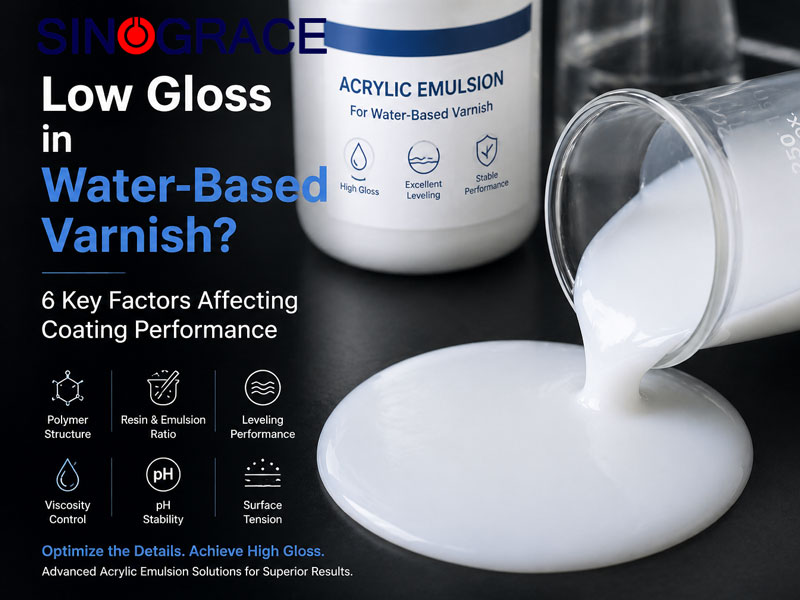
    1. The influence of polymer monomers on the glossiness of water-based Overprint Varnishes The polymer monomers selected for the film-forming resin in the water-based varnish formulation have a significant impact on the glossiness of the finished product. In actual production, multiple monomers are usually used for copolymerization. The acrylic resin used in water-based varnish can be made from monomers such as methyl methacrylate, styrene, acrylic methyl ester, acrylic β-hydroxypropyl ester, and acrylic. Increasing the dosage of methyl methacrylate and styrene leads to a harder coating with good glossiness, but it is also more brittle and has poorer flexibility and solubility resistance. 2. The proportion of water-soluble resins and emulsions in the varnish formula Increasing the dosage of emulsions can enhance the glossiness of the varnish, but it will reduce the leveling and processing suitability of the varnish; increasing the dosage of water-soluble resins can improve the leveling and processing suitability of the varnish, but the glossiness will decrease. 3. The influence of leveling on the glossiness of water-based varnish Leveling is an important factor affecting the glossiness of water-based varnish. Leveling is influenced by product viscosity, pH value, and surface tension. Choosing an appropriate leveling agent can effectively improve the construction leveling performance. If the varnish has good leveling, it can quickly level before the coating dries, forming a smooth surface, and the coating will have high glossiness; if the varnish does not dry before leveling, it will leave some streaks, sand holes, etc., reducing the glossiness. 4. The influence of pH value on glossiness The pH value of water-based varnish should generally be controlled between 8 and 9. The pH value is mainly adjusted with ammonia water. If the pH value is too high, the viscosity of the varnish will decrease, affecting the glossiness and causing a slower drying speed and poorer water resistance; if the pH value is too low, the viscosity will increase, and ammonia water will volatilize relatively quickly during leveling, causing the leveling process to end prematurely and affecting the final film formation glossiness. 5. The influence of viscosity and solid content of the finished product on glossiness The viscosity of the finished product has an important impact on the leveling, wetting, and other properties during coating application. The surface of the printed product has a certain absorption capacity for the varnish, and the absorption rate of the printed surface for the varnish is proportional to the viscosity value of the varnish. If the viscosity value of the varnish is too small, when coating on paper with a high absorption rate, it will cause too large a change in the viscosity of the varnish during leveling, resulting in premature ending of leveling, causing uneven coating on the surface of the printed product, and affecting the smoothness and glossiness o...

    read more

Copyright © 2015-2025 Anhui Sinograce Chemical Co., Ltd..All Rights Reserved.powered by dyyseo.com

top